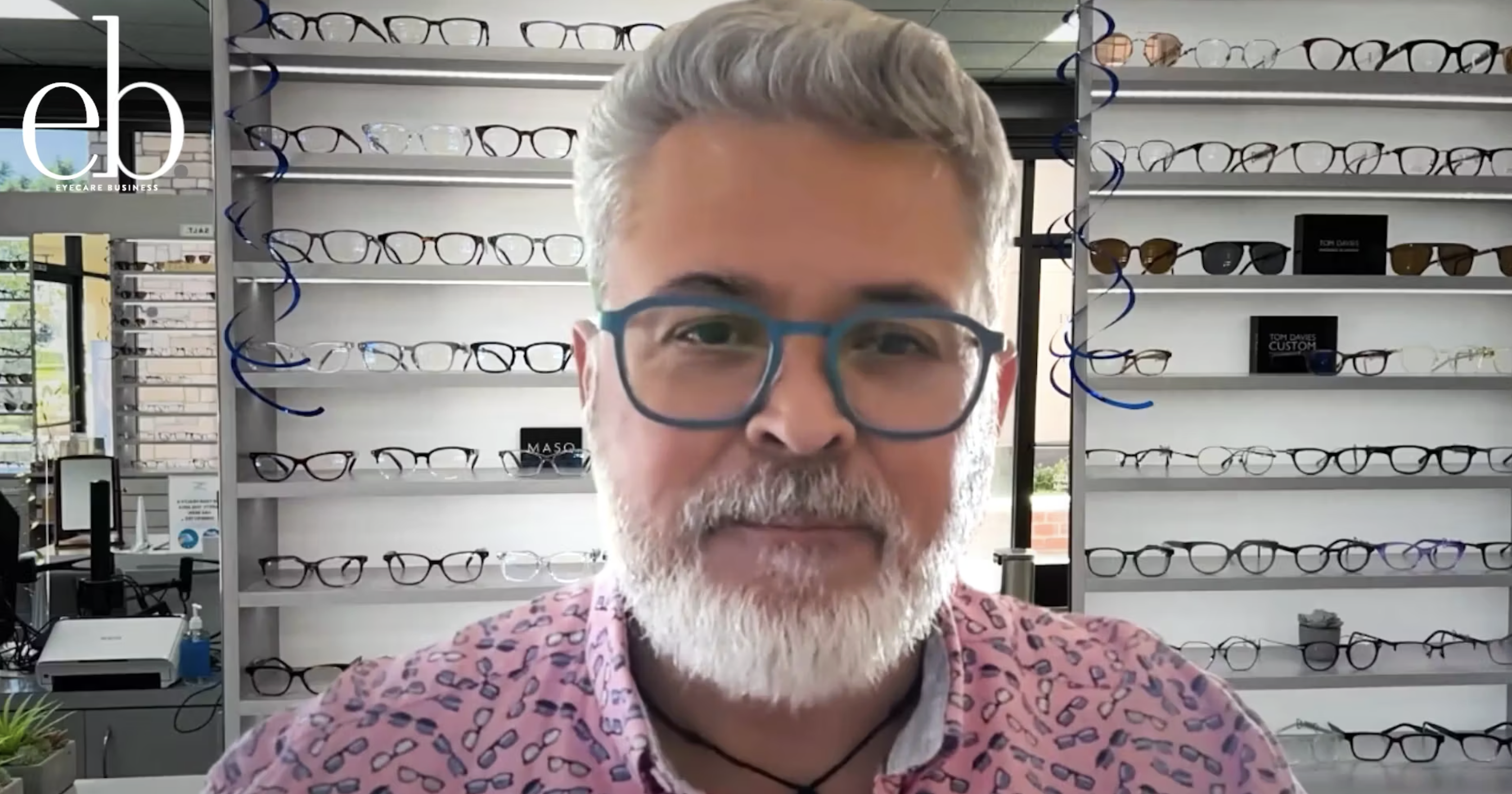

Eyecare Business connects with the founder of Buena Vista Optical, cofounder of Latinos En Optometry, and EB board member Diana Canto-Sims, OD, for the first installment of The Inside View—a video series dedicated to exploring overarching conversations taking place across the eyecare industry. Here, Dr. Canto-Sims highlights the skills most critical for emerging practitioners, strategies to attract the next generation of talent, and approaches for practices to build career pathways that enhance staff retention.
Dr. Canto-Sims: My name is Dr. Diana Canto-Sims, and I own a practice in the heart of Chicago, Buena Vista Optical, and we have been in practice for 21 years on Valentine's Day, February 14.
EB: What skills will be most important for future eyecare professionals?
Dr. Canto-Sims: Clinical excellence will always be the foundation of our practice. However, it's important to have other skills to be able to really excel in our profession. The first one I want to talk about is communication—communication with cultural competence, but also emotional intelligence. A patient may not remember every single test that you performed, but they will remember how you made them feel. Being able to clearly explain their diagnosis and treatment, but also being aware of those emotional cues and those cultural cues, is essential. Patients will trust you. They will understand the diagnosis and follow your treatment, and they will refer their family and friends so that you can grow and scale your practice.
Another skill that's important is feeling really comfortable with technology. Technology is not going to replace our profession, but it will enhance our profession. We're able to use artificial intelligence and technology to analyze data for our patients so that we can spend more face time. We're able to use technology to help our staff have a better flow in the optical, replacing everyday tasks with automated systems. So it's important that you start implementing technology in your practice, and maybe you feel that you're not an early adopter, but it's important that you start somewhere—maybe schedule every quarter implementing new technology.
Another skill that's important is feeling really confident about your prescription and your recommendations. Eye care is health care, and we're here to provide eye care solutions to our patients. Being able to know what is out there—the lenses, the treatment—is important so that we can recommend and prescribe solutions for our patients.
EB: How can the industry attract the next generation of talent?
Dr. Canto-Sims: First of all, we need to show them what we do in eye care and that eye care is the future, not just a job. The newer generations love to be on social media. I mean, that's a fact. And if you have a practice, what better way than to share a day in the life of an eyecare professional? If you do a specialty, it's great that you showcase your specialty. The newer generation is absolutely fascinated by specialties like ortho K, which by itself is fascinating. Maybe you want to share the technology that you use to diagnose and treat your patients. You can share your entrepreneurial journey, because the next generation really loves entrepreneurship. Owning a practice means that you are a professional and an eyecare professional, but you're also a business owner. You can showcase the fashion in eye care. All of these aspects and modes of practice are very attractive to the next generation, and social media is a great way to showcase them.
Also, we need to show up earlier, early exposure, because a lot of students who are interested in a career in health care, they don't even know that being an eyecare professional is an option. So showing up early—how can we do this? We can work with our local schools on a career fair. We can also do a paid internship, or we can do shadowing. Maybe you don't have time to do a career day or shadowing, but you can always collaborate with organizations and optometry, like the American Optometric Association and the Association of Schools and Colleges of Optometry. Latinos en Optometry is a nonprofit that collaborates with another organization called Young Mind Inspired, and they have an entire platform nationwide where you can volunteer and talk to thousands of students via Zoom about your profession and how much you love it.
EB: How can practices build career pathways to improve retention?
Dr. Canto-Sims: Retention is really valuable. When you look at hiring, the cost of hiring is a lot more than you think. Studies show that hiring a new staff member can cost anywhere from 50% to 200% of their salary. Not only that, it's not just the cost of the advertisement—it's the energy, the resources, and the time that you put into hiring, training, and onboarding your staff. Also, your current staff sometimes feels the burden because they have to teach the new staff member all the processes and procedures. The cost of hiring is way more than you think, so retention is so important.
How do you retain incredible staff members? In our practice, we have staff members who have been with us for 17 years, 15 years, and they are not the same person that they were when we hired them. Why? Because it's important that they grow within your practice.
From the moment you hire, we have a strategy. When we interview a new hire, we tell them, “Well, we see that you're applying for the position of receptionist. However, we want to let you know that you can grow in our practice. You can get certified to be an optician. You can work in our clinical department and be an ophthalmic technician. You can learn how to make glasses inside our lab, and you can learn administrative tasks by processing patient plans.” So, there is an opportunity to grow. This way, the candidate knows that they have a future career with you and they're just not thinking of a job and a paycheck for 1 or 2 years—because retention is so important.
Another way to retain your employees is to listen. Check-ins and mentoring are really important. A lot of times, staff members leave because they feel like they're not growing or they feel stuck. One way to help them is to give them the opportunity to learn new skills, pay for different certifications—because when your staff member feels that they're growing within your practice, they're going to stay.
It's important that you do check-ins regularly, and I'm not talking about performance reviews. Those are important. More like quarterly check-ins. So every few months, all you need is 5 or 10 minutes and ask them simple questions: What is feeling heavy? What is working? What are we currently doing that you like and you want us to continue to do? What are we currently doing that is not working and you would like us to stop?
In our practice, when we hire, we have a 3 plus 3 plus 3 strategy. Once they have been hired, we meet with them in 3 days, 3 weeks, and 3 months. So after 3 days, we sit down, we do a check-in. You know, we talk about what is going well and what they need to improve. Three weeks later, the list is a little longer, so we talk about what they're doing well, what needs to improve. And then 3 months later, we check in again. And then we do this quarterly. This is the way to get the feedback that you need from your staff to be able to give them the support that they need, so that your retention rate can be high. This way, they are able to learn new skills and be with you. When you teach them new skills, these are skills that they're able to use every day in their life, not just in your practice—so it helps you, but it also helps them. And cross-training is important too, because if they know that they have the opportunity to learn other departments, they know that they can grow, and it helps your practice, because if you're understaffed now, you have other staff members that can fill in. And that is a great way to retain your staff because constantly hiring is just a financial burden and it requires a lot of resources, time, and energy.